
Woven metal fabric is made from fine metal wires, commonly using silver-plated copper wire and stainless steel wire. Silver-plated copper wire is available in a range of colors, allowing the woven design to display rich, multi-colored visual effects. Thanks to its fine weaving structure, the metal fabric can create varied and striking effects under different lighting conditions.
The fine weaving technique also enables extensive customization. Patterns can be woven according to project requirements, including geometric shapes, portraits, landscapes, text, and abstract art. This product is widely used as an interior decorative material for wall covering, metal partitions, laminated glass, and metal art panels.
Its key advantage is customizable patterning, making it a flexible solution for decorative and artistic interior applications.
Wire Ø 0.1—0.5mmCustom pattern designArt of woven metalWoven metal interiors
Free A4 sample · drawing support · export packing and full document set.
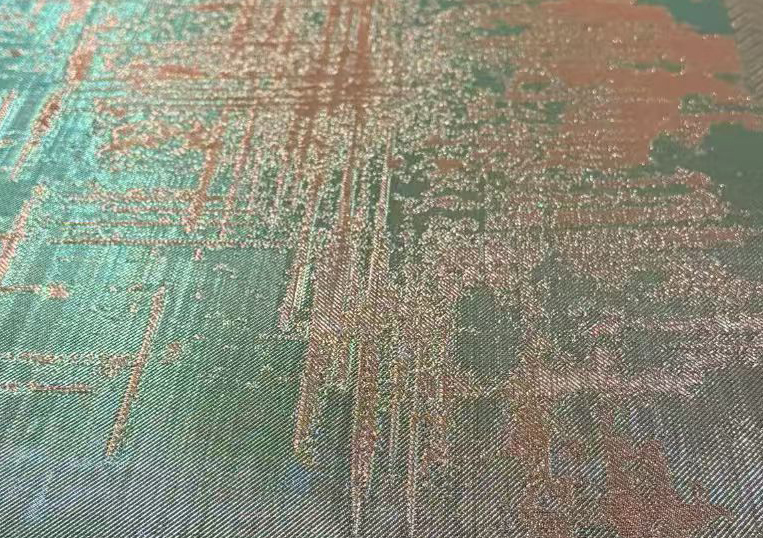
A woven image, not a printed one
The pattern is in the weave. Wires of different tones are carried through the sheet wherever the image needs them, so the picture is built from metal rather than printed onto it. There is no printed layer on the surface to scrub off in a corridor.
That also changes how it reads. A woven surface shifts between light and shade as you walk past, and it looks different from an angle than it does head-on — which is why a portrait or a landscape works on a reception wall, and why a photograph of it reads as a flat grey field. Approve the sample in the light where the panel will hang.
It is used where an image has to survive close viewing and cleaning: wall covering behind a reception desk, partition screens, framed art panels, and laminated glass with the weave sealed inside the glass.
- Detail is set by the wire. At 0.1 mm the weave holds fine line work and small lettering; coarser wire gives a bolder, more graphic image and a stronger surface.
- The image is the material. Tones come from the wire itself — silver-plated copper for a multi-tone image, stainless steel where a neutral metal surface is enough.
- Read it at the distance it will be seen. A portrait that works across a lobby can dissolve into texture at arm’s length; a sample of the critical area settles that in a minute.
- Metal only, unless you ask otherwise. No ink and no backing as standard, so the surface can be wiped and the fire story stays simple.
Specifications
The artwork and the wire are chosen together: fine line work needs the finer wire, and a wide panel needs a weave that holds the pattern repeat across the width. Ranges below are indicative — tell us the image and the panel size and we will confirm the rest.
| Parameter | Range | What it changes |
|---|---|---|
| Base material | Silver-plated copper, stainless 304 / 316, brass, copper | How much tone the image can carry, and how the surface ages |
| Wire diameter | 0.1 – 0.5 mm | The finest detail the weave can hold |
| Weave | Plain weave, twill, image weave | How the image resolves and how the surface catches light |
| Pattern | Woven from your artwork — geometric, portrait, landscape, text, abstract | The image itself; lettering is redrawn so the weave can hold it |
| Tones | Multi-tone, matched on an approved sample | How many shades in one panel, and how closely they are held |
| Panel size | Made to your panel or opening size | Joints and pattern repeat are set out on the drawing |
| Backing | None as standard; translucent or opaque on request | Whether the image reads solid or lets light through |
| Weight | Confirmed at quotation | Handling, frame and fixing |
| Minimum order | Confirmed at quotation | Sample of the weave before production |
Materials and finishes
Tone is the point of this material, so the base metal is chosen before the artwork is separated.
| Material | Colour and finish | Best for | Avoid when |
|---|---|---|---|
| Silver-plated copper | Bright, takes colour; several tones in one panel | Portraits, landscapes, art panels, wall covering | Damp or coastal interiors without protection — the plating carries the tone |
| Stainless 304 | Neutral grey; satin or bright | Interiors where a metal surface matters more than a picture | The artwork needs several tones |
| Stainless 316 | Neutral grey; satin | Humid interiors, kitchens, pool areas | The site is dry and the budget is tight |
| Brass / copper | Warm, darkens with age | Feature panels that can patinate | The tone has to stay exactly as approved without a coating |
From artwork to woven panel
An image has to be separated before it can be woven, and what the wire can hold is decided at that stage rather than on the loom.
- Send the artwork, the finished panel size and the distance it will be seen from.
- We separate the image into weave and tone areas, and say where the detail has to be simplified.
- A sample of the critical area is woven in the actual wires and approved by you.
- The panel is woven and checked against that sample for tone and pattern repeat.
- Edges are finished, the panel is packed flat or rolled, and the documents go with it.
Woven pattern against printed and perforated
Printed and perforated surfaces solve part of the same brief. The difference is what survives handling, cleaning and a change of light.
| Solution | Image detail | Changes with light | Cleanable | Cost |
|---|---|---|---|---|
| Woven metal fabric | Fine, set by the wire | Yes — metal sheen | Yes, damp cloth | Medium–high |
| Printed metal sheet | Photographic | No | Yes, with care — ink scratches | Medium |
| Perforated / etched sheet | Coarse — holes and voids | Slight | Yes | Medium |
| Printed textile wallcovering | Photographic | No | Spot clean only | Low |
Rule of thumb: if the image has to be metal and survive cleaning, weave it. If it has to be photographic at arm’s length, print it on metal. If it is a graphic read from three metres, a perforated sheet does the job for less.
Fixing the panel
How the panel is held decides the frame, and the frame is visible, so it is chosen with the image rather than after it.
Framed panel
The usual detail for art panels and wall covering: an aluminium or stainless frame, the weave stretched or bonded behind it, and the frame edge read as a design line.
Tensioned on a subframe
For a long wall, the fabric is stretched on a subframe fixed to the wall, which keeps one flat field across several panels without a visible joint.
Laminated in glass
The weave sits inside the laminate. The laminator sets the glass, the interlayer and the rating; we supply the mesh and the artwork separation.
Bonded to a substrate
Direct to a flat, dry substrate such as MDF or plasterboard, with a test piece approved on site first.
Send the panel size, the substrate and the direction the light falls. We will state the largest panel we would weave without a joint, and where the joint would sit.
Where woven metal fabric is used
Wall covering
Reception walls and corridors where the image is seen at close range. See the application →
Partitions and screens
An image carried through a screen without closing the room. See the application →
Laminated glass
Weave sealed inside glass for doors, partitions and balustrades. See the application →
Art panels
Portraits, landscapes and lettering as framed pieces. See the application →
Samples and finish
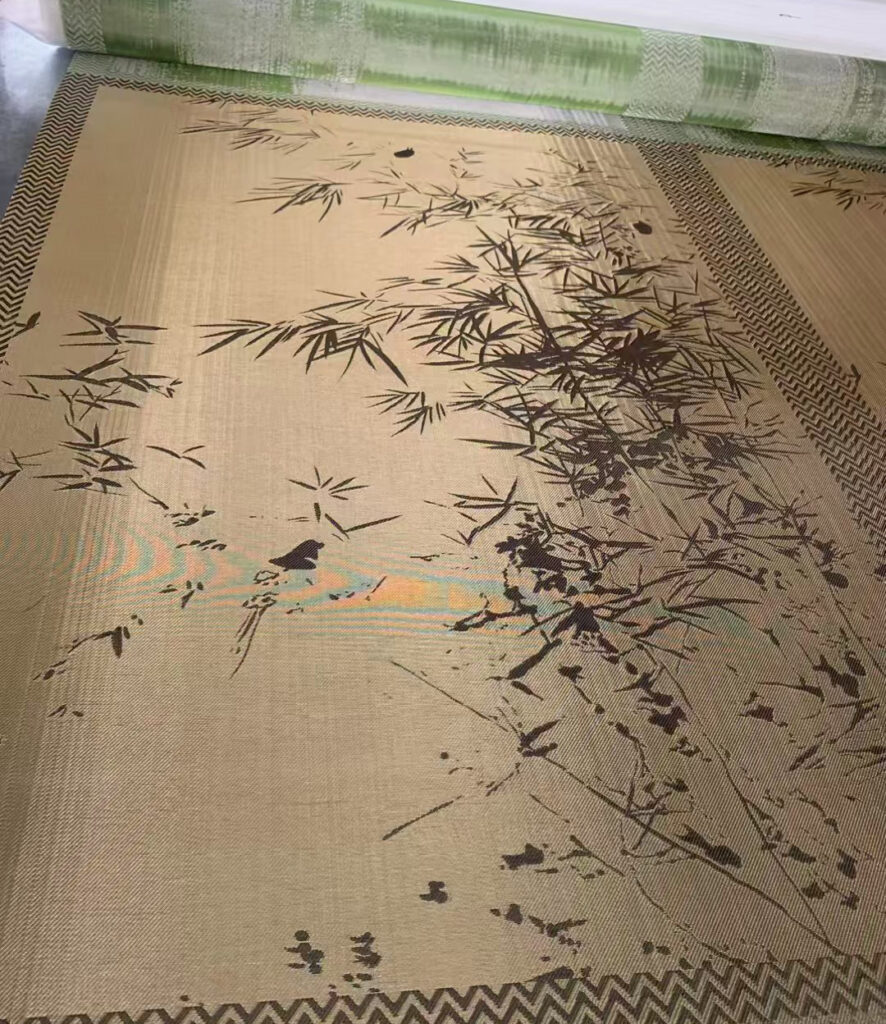
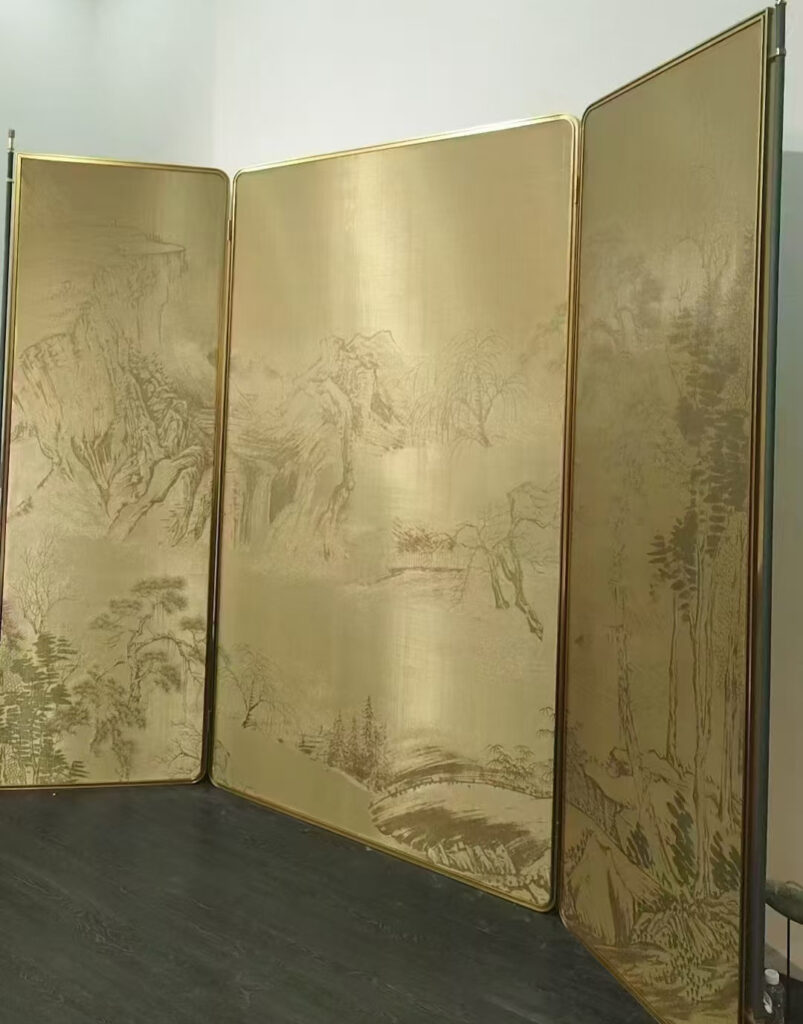
The A4 piece is not a colour print; it is the same weave and the same wire as the panel. Judge it in the light where it will hang, from roughly the distance it will be seen.
Ordering and lead times
| Item | Detail |
|---|---|
| Minimum order | Confirmed at quotation |
| Lead time | Confirmed at quotation |
| Sample | A4 detail sample in the chosen wires |
| Artwork | Vector where possible, or raster at the final panel size |
| Pattern repeat | Set out on the drawing before weaving |
| Packing | Flat panel or roll, edges protected |
| Documents | Material test report, packing list, invoice |
| Terms | FOB / CIF / DDP |
Lettering and logos are redrawn for the weave — send vector artwork where you have it, and tell us the smallest letter height that has to stay legible.
Frequently asked questions
What is woven metal fabric?
A metal cloth woven from fine wire and used as a decorative surface. The image is made by carrying different wires across the weave, so the pattern is part of the material instead of a print on top of it.
How is the image made?
The artwork is separated into weave and tone areas, then wires of different tones are carried across the warp wherever the image needs them. Nothing is printed on the surface, so there is no ink layer to scratch or fade away.
What artwork do you need?
Vector where possible. For a photograph, send the largest version you have and tell us the panel size and viewing distance; lettering and logos are redrawn so the weave can hold them.
How fine can the detail be?
At 0.1 mm wire the weave holds fine line work and small lettering. What reads as detail depends on the distance, so we send a sample of the critical area rather than a screen image.
Can you match a colour?
On silver-plated copper the tones are matched to an approved sample, not to a screen. Stainless steel keeps a neutral metal tone and cannot carry a full colour image.
Can it be laminated in glass?
Yes — the weave is used as the interlayer. Glass type, interlayer and any rating are set by the laminator; we supply the mesh and the artwork separation.
Can it be used outside?
As standard the material is for interiors. Where a panel has to face weather we would steer you to rigid woven mesh, where a flat plane and a colour set by the alloy or finish do the work instead of an image.
How is it cleaned?
Dust with a soft brush or vacuum on low suction. For marks, a damp cloth with mild detergent, then dry. No abrasives or solvents on a plated surface.
Send the artwork and the panel size
Send the image, the finished size, the viewing distance and where it will hang. We reply with the wire, the weave, the tone range and a price — or a detail sample first, if the artwork is still being chosen.
Sales: sales@decorwiremesh.com · Reply within one working day · Setting-out drawings with every order.