
A metal mesh partition divides a space without closing it off. Woven wire or coil mesh on a track or frame gives a room a boundary while daylight, sightlines and airflow still pass through — and because the sheet is wire only, the partition adds no fuel load to the floor it stands on. We make the mesh to the opening, supply the track detail and issue setting-out drawings so the screen lands on the ceiling grid, not beside it.
No combustible contentSee-through both waysTrack or fixed frameMade to opening size
Send the opening and a photo of the space — we will come back with the system, the track and a price.
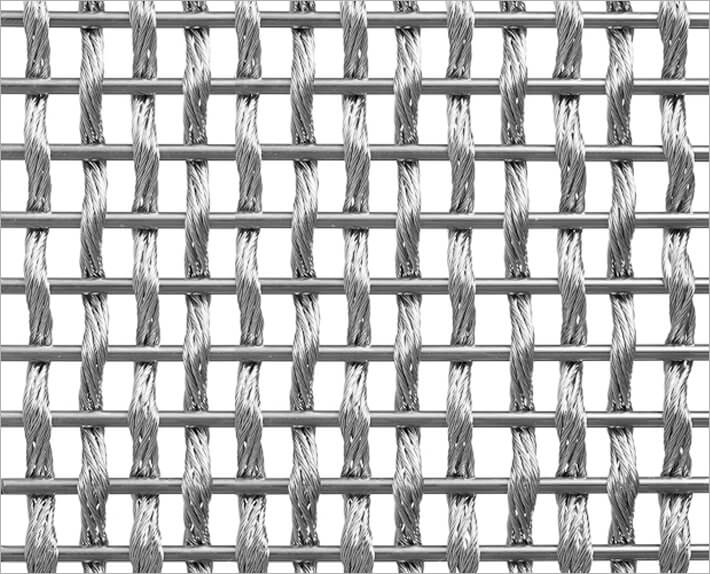
What actually decides a partition brief
Most partition enquiries start with a photograph and end with a fire strategy. These are the four things that decide the specification, in the order they usually come up:
- Sightlines, not privacy. A single layer filters a view; two layers offset by half an aperture block it. Decide which one the space needs before the material is chosen.
- Light and air. A mesh screen keeps a corridor daylit and lets air move, which is why it is used where a solid wall would make the plan feel shut.
- Fire load. The mesh is wire only — no fabric, foam or adhesive — so it adds nothing combustible to the space. Where a documented rating is required, tell us the standard and we will confirm which test reports we hold.
- What holds it up. A curtain hangs from a track and loads the ceiling; a framed screen loads the floor and the wall. That choice usually matters more than the pattern.
Three systems that work for partitions
The same brief can be solved three ways. The difference is how much the screen should look like a curtain, and whether it has to open.
Metal coil drapery
Drawable curtains on a track, wide loose folds, the most transparent option. Best where the screen has to open and close. See the mesh →
Woven wire drapery
Crimped cloth that hangs in soft pleats, denser and more fabric-like. Best where the divider should read as a curtain, not a screen. See the mesh →
Woven mesh panels
Rigid framed or tensioned panels, floor to ceiling, no folds. Best for a fixed architectural screen that reads as a wall. See the mesh →
Four configurations
Fixed framed screen
Floor to ceiling, framed on four sides and fixed to the slab and the wall. The most architectural reading, and the easiest to make airtight at the edges.
Drawable curtain on a track
Swivel track with carriers, curtain stacks to one side. Use where the space has to open for events or servicing.
Double layer for privacy
Two curtains offset by half an aperture. Each layer stays transparent; together they read as a solid screen while air and light still pass.
Curved or raked
Mesh follows a radius or a rake because it is made to the opening rather than cut from a sheet. Setting out matters more than with a flat panel.
Constraint to approach
The table the specification usually ends up on: what the space demands, what we would do about it, and what it costs you elsewhere.
| Requirement | Approach | The trade-off |
|---|---|---|
| Privacy | Double layer, or a finer aperture | Less light and a heavier track load |
| Acoustics | Absorptive backing behind the mesh | Backing is not invisible — it changes the look |
| Fire strategy | Wire-only mesh, no backing | No absorption; a rating needs documented test reports |
| Cleaning access | Drawable curtain or hook-on panels | A fixed frame cannot be opened for access |
| Structure | Track into the slab, or framed screen to the floor | Track needs a fixing detail at ceiling level |
| Long spans | Modules with joints on the setting-out drawing | Visible joints unless the module lines are designed |
Detailing and fixing
Head detail
A track or a frame at the ceiling line. The ceiling is usually already set out when the enquiry arrives, so tell us the grid module — the head detail is what decides whether the screen sits on a grid line or beside it.
Floor and wall junction
A drawable curtain needs a floor guide or a weighted hem; a fixed screen needs a shoe or a frame fixed to the slab. Both change the finished edge, so they are decided before the mesh is cut.
Junctions with glazing, columns and doors
Where the screen meets glass or a column, the edge has to be closed rather than cut. We supply the edge detail with the setting-out drawing so the junction is built, not improvised on site.
Every order ships with setting-out drawings. Send the ceiling grid, the opening and the substrate, and the drawing will show where the track lands and what the structure needs to carry it.
Sequence on site
A partition fails at the interfaces more often than in the mesh. These are the four things to settle before anything is manufactured:
- Confirm the opening — three site measurements, not the drawing dimension.
- Confirm the head: track into slab, into a ceiling, or a frame to the structure.
- Confirm the floor: guide, shoe, or a free hem.
- Confirm access: does the screen have to open, and does anything behind it need servicing?
- Approve the sample — aperture, finish and pleat are approved on a physical piece, not a render.
Documents and compliance
We supply the mesh, the edge detail and the setting-out drawings. For the project file we can provide a material test report, packing list and invoice with each order, and confirm which test reports we hold for the specific standard your project is checked against.
What we will not do is quote a fire class, an acoustic rating or a fall-protection certificate we cannot evidence. If the specification needs one, tell us the standard early — that conversation changes the system, not just the paperwork.
Finish and sample
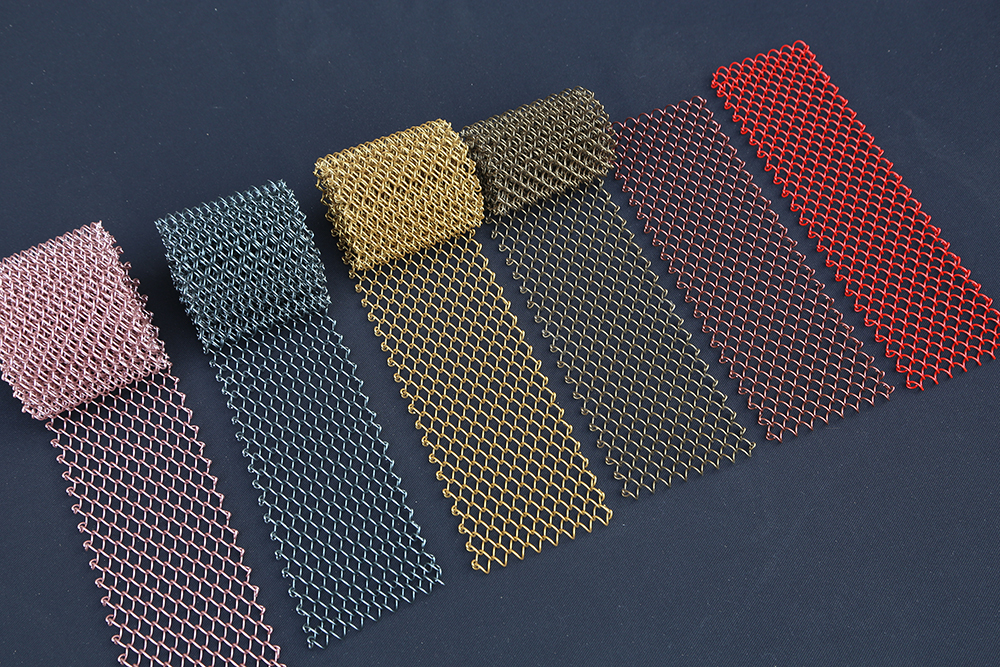
Partitions are approved on a sample: aperture, finish and how the sheet hangs. Ask for a hanging piece rather than a flat one — the pleat is what the client will actually see.
Ordering and lead times
| Item | Detail |
|---|---|
| Minimum order | Confirmed at quotation |
| Sample | Free A4 sample on request |
| Lead time | Confirmed at quotation, after the head detail is fixed |
| Packing | Export carton and pallet, edge protected |
| Documents | Material test report, packing list, invoice |
| Terms | FOB / CIF / DDP |
| Drawing support | Setting-out drawings with the order |
Order the track and the mesh together. A curtain made to one carrier pitch will not hang evenly on another, and the track is the part that usually arrives late.
Frequently asked questions
Can a mesh partition be used as a fire-rated screen?
The mesh itself contains no combustible material — no fabric, foam or backing — so it adds no fuel load. Whether a partition satisfies a documented rating depends on the standard and the whole assembly, so tell us the standard and we will confirm which test reports we hold rather than quote a class.
Will a mesh partition give privacy?
A single layer filters a view rather than blocking it. For real privacy, specify two layers offset by half an aperture: each layer stays transparent, the pair reads as a screen, and light and air still move.
How is it cleaned?
Dust with a soft brush or vacuum on low suction; wipe with a damp cloth and mild detergent, then dry. Mirror-polished finishes show water marks, so dry rather than air-dry.
Does it need a track in the ceiling?
A drawable partition does. A fixed screen can be framed to the floor and wall instead. The choice changes the edge detail, so it is settled before the order.
Can it run floor to ceiling on a curve?
Yes. The mesh is made to the opening rather than cut from a sheet, so a radius or a rake is a setting-out exercise rather than a special product.
How do we access services behind the screen?
Specify a drawable curtain or hook-on panels. A fixed frame cannot be opened, which is why access is one of the four questions we ask first.
Will it make the room quieter?
Not on its own — mesh is transparent to sound. Combined with an absorptive backing it reduces reverberation, but the backing becomes visible behind the mesh, so it is a design decision too.
What is the minimum order and lead time?
MOQ is confirmed at quotation, as is the lead time once the head detail is fixed. A free A4 sample is normally available on request.
Request a quote for a mesh partition
Send the opening size, a photograph of the space and the ceiling detail. We will come back with the system, the track, the edge detail and a price.
Sales: sales@decorwiremesh.com · Reply within one working day · Setting-out drawings with every order.