
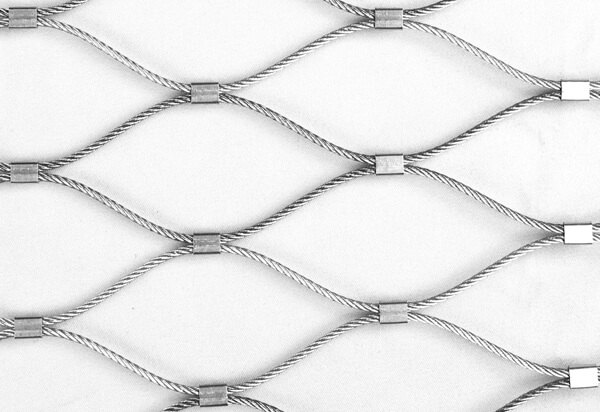
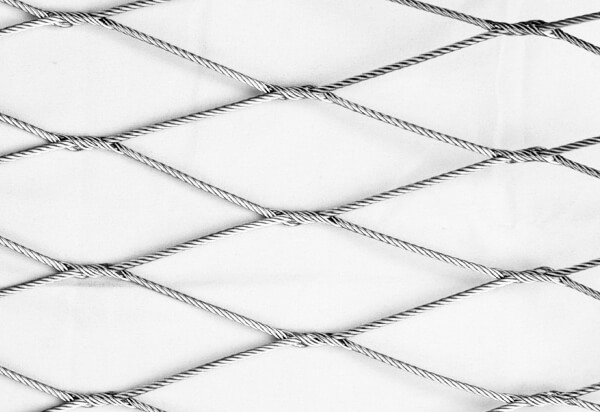
Stainless steel rope mesh is a cable net with a diamond aperture. Wire rope strands are joined at every crossing —by ferrules or by a woven sleeveless construction —into a flexible, high-strength sheet. Because the cables are thin, it almost disappears at a distance, which is why it is used for balustrades, fall protection, animal enclosures and green-wall support.
Cable Ø 1.0—6.0 mm7×7 or 7×19 strandFerruled or sleevelessMade to opening size
Free A4 sample · drawing support · export packing and full document set.
Strength you can see through
A cable net carries load along the rope, not across a panel, so it spans between fixings with almost no depth. That makes it the right answer where a barrier has to be strong but visually light: balustrades on an atrium, fall protection over a void, an enclosure that must not look like a cage.
The aperture is set by the spacing of the ropes, so the visual density can be tuned from a fine net to a wide diamond without changing the fixing.
- High strength, low visual weight. Load runs in the ropes, so the mesh needs very little depth and no frame.
- Ferruled or sleeveless. Ferrules give a defined diamond and easy inspection; sleeveless (Webnet) construction removes the fittings for a cleaner line.
- Corrosion controlled by grade. 316 for coastal, marine and chemically exposed sites; 304 for dry interiors.
- Flexible on site. The net is tensioned after installation, so minor setting-out tolerance is absorbed rather than built into frames.
Specifications
Cable, strand and aperture are chosen together with the span and the load case. Ranges below are the standard programme.
| Parameter | Value | What it changes |
|---|---|---|
| Cable material | AISI 304 / 316 stainless steel | 316 for coastal, marine and chemically exposed sites |
| Ferrule material | AISI 304, 316, aluminium | Non-sleeved (Webnet) construction also available |
| Cable construction | 7×7 and 7×19 strand | 7×19 is more flexible; 7×7 is stiffer |
| Mesh size | Made to order | Opening size is set by the cable spacing |
| Panel size | Made to your opening | Supplied to project dimensions |
| Finish | Natural stainless, or black / coloured coating | Mill finish is the standard |
| Typical uses | Balustrade infill, fall protection, animal enclosures, green-wall support | Almost invisible at a distance, which is why it suits enclosures |
| Minimum order | Confirmed at quotation | Sample piece on request |
Grade, strand and ferrule
Three choices decide both the look and the service life.
| Choice | Options | Best for | Avoid when |
|---|---|---|---|
| Grade | 304 / 316 | 316 outdoors and near water | 304 at a marine site |
| Strand | 7×7 / 7×19 | 7×19 where flexibility matters | 7×7 where the net must stay stiff |
| Ferrule | Stainless, copper, aluminium | Stainless for exposed sites | Aluminium near chlorides |
| Construction | Ferruled / sleeveless | Sleeveless where the line must be clean | Ferruled where every crossing will be inspected |
How a rope net is made
Rope mesh is assembled, not woven on a loom —which is why the panel can be made to a shape, not just a rectangle.
- Rope cut to length and, where required, pre-stressed.
- Ropes laid out to the aperture and orientation on the jig.
- Crossings joined —ferrules crimped, or ropes interwoven for sleeveless mesh.
- Net trimmed and edge ropes fitted for tensioning.
- Inspected, coiled and packed with the tensioning schedule.
Rope mesh against the alternatives
The comparison that decides a barrier is usually strength against how much it hides.
| Solution | Strength | Visual weight | Needs a frame | Curves |
|---|---|---|---|---|
| Rope mesh | High | Very low | No —tensioned | Yes, on a curve |
| Rigid mesh panel | High | Medium | Yes | Limited |
| Vertical cable only | High | Very low | No | Yes |
| Glass balustrade | High | High (reflective) | Posts and shoe | No |
Rule of thumb: if the barrier must be nearly invisible, rope mesh. If it must also stop small objects, reduce the aperture rather than adding a second material. If privacy is the point, glass or a solid panel.
Tensioning and fixing
A rope net is only as good as its tensioning, so the fixing detail is part of the product.
Between posts
The usual balustrade detail: posts at set centres, net tensioned between them, edge rope captured in the post or in a tensioner.
Perimeter frame
For an opening in a wall or slab. The frame takes the tension, so the net can be a simple rectangle.
Curved and free-form
The net follows the geometry because it is assembled, not pressed. Setting-out still matters: the fixings must be on the true curve.
Give us the span, the load case and the fixing centres. Deflection under load, not the breaking strength, is normally what decides the cable size —and that calculation is what we need the span for.
Where rope mesh is used
Balustrades and railings
Atrium guarding that stays visually open. See the application →
Fall protection
Void protection and roof edges. See the application →
Animal enclosures
Zoo and aviary netting. See the application →
Green-wall support
Climbing-plant support on a facade. See the application →
Panel and net samples
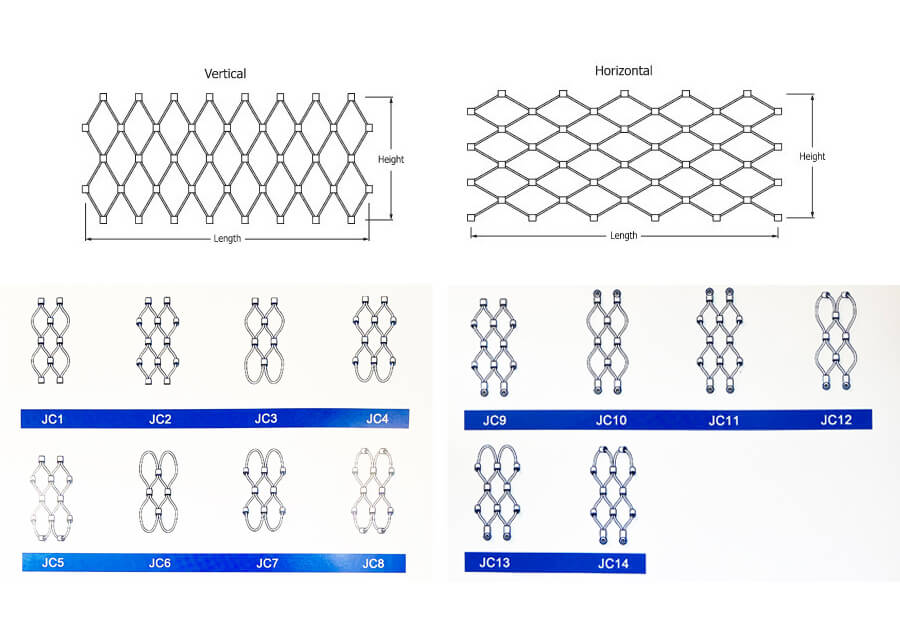
For a barrier, ask for the tensioning schedule with the sample. It states the cable, the aperture and the deflection the net is designed to, which is what a checking engineer will ask for.
Ordering and lead times
| Item | Detail |
|---|---|
| Minimum order | Confirmed at quotation |
| Lead time | Confirmed with the tensioning schedule |
| Sample | Free A4 sample on request |
| Packing | Export carton and pallet, edge protected |
| Documents | Material test report, packing list, invoice |
| Terms | FOB / CIF / DDP |
| Drawing support | Setting-out drawings with the order |
Rope nets are made to opening size, so the fixing centres must be confirmed before production —a 20 mm error at the posts becomes a visible sag at the centre.
Frequently asked questions
What is stainless steel rope mesh?
A cable net: stainless wire ropes joined at every crossing into a diamond sheet. It carries load along the ropes, so it is strong but visually very light.
Ferruled or sleeveless —which should I choose?
Ferrules give a defined diamond and are easy to inspect crossing by crossing. Sleeveless (Webnet) construction removes the fittings for a cleaner line. Both are available.
Which grade should I specify?
316 for coastal, marine and chemically exposed sites; 304 for dry interiors. The grade matters more than the finish for service life.
Is it strong enough for fall protection?
Yes, but the design is set by the load case and the permitted deflection, not by the breaking strength of the cable. Give us the span and the load case and we will size the cable.
Will it sag over time?
A correctly tensioned net does not. Tension is set after installation, and the tensioning schedule states what it should be.
What sizes can you produce?
Panels are made to your opening rather than cut from a standard sheet. Aperture is set by the cable spacing, so it can be tuned without changing the fixing.
Can it follow a curve?
Yes. The net is assembled, not pressed, so it follows the geometry —but the fixings still have to be set out on the true curve.
How is it cleaned?
Fresh water rinse in coastal installations, and a soft brush for dust. Avoid chloride-based cleaners on 304.
Send the span and load case for a rope net quote
Post centres, the height, what the barrier has to stop and the environment —that is enough for us to size the cable and price the net.
Sales: sales@decorwiremesh.com · Reply within one working day · Setting-out drawings with every order.