
Metal coil drapery is a flexible curtain made of coiled wire links joined into a flat diamond mesh. Because the links are coiled rather than woven on a loom, the sheet has no rigid crimp points, so it folds, swags and hangs on a track like fabric — while remaining metal. It is specified for partitions, ceiling features and window treatment in stainless steel, aluminium, carbon steel, made to your opening size.
Wire Ø 1.0–2.0 mmAperture 6–12 mmWidth made to orderMOQ 10 m²
Free A4 sample in 7 days · drawing support · export packing and full document set.
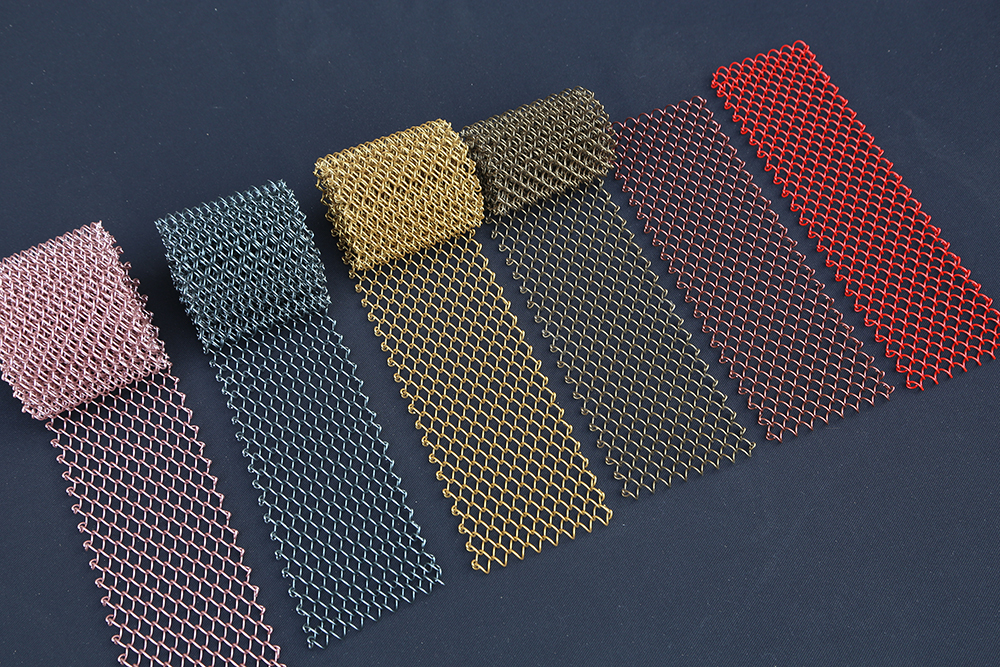
What metal coil drapery is
The weave is the same in every build: wire is coiled into uniform rings, then cross-linked into a continuous diamond sheet. What changes is the wire diameter and the aperture, which together set how open the curtain reads, how much it weighs and what span it can hold.
- Transparent in both directions. Open area stays uniform across the full sheet, so a partition divides a room without darkening either side and a ceiling can conceal services without reading as a solid lid.
- Made to the opening. Curtains are woven to your panel or opening size, so a wide span needs fewer joints and fewer visible seams.
- Light on structure. At around 4.0 kg/m² the load per square metre is modest, which matters on retrofit ceilings where the track, not the mesh, is the constraint.
- No combustible content. The curtain is wire only — no fabric backing, foam or adhesive. If your project needs a documented fire rating, tell us the standard and we will confirm which test reports we hold.
Three build options
Standard coil
Wire 1.2 mm
Aperture 8.5 mm
Overall 7.1 mm
Weight 2.0 kg/m²
General partitions, ceiling features and lobby screens. Held in stock — one week.
Fine coil
Wire 1.0 mm
Aperture 6 mm
Overall on request
Weight lighter drape
Window treatment and small-scale interiors where a finer, softer fold is wanted.
Heavy coil
Wire 2.0 mm
Aperture up to 12 mm
Overall on request
Weight heaviest option
Wider spans and exterior screens where the curtain has to hold a line in wind.
Specifications
Standard build shown. Values outside these ranges are possible on request — send the drawing and the opening size and we will confirm what the loom can hold.
| Parameter | Standard / range | What it changes |
|---|---|---|
| Material | SS304, SS316, aluminium, brass, copper | 316 for coastal, humid or pool areas |
| Wire diameter | 1.0 – 2.0 mm | Heavier wire = more rigid, less transparent |
| Aperture | 6 – 12 mm | Set by wire diameter and coil pitch |
| Overall thickness | 7.1 mm (standard) | Includes the coil depth, not just the wire |
| Weight | approx. 4.0 kg/m² | Used for track and fixing load |
| Curtain width | Made to your opening size | No standard sheet limit; joints set on drawing |
| Surface finish | Mill, satin, mirror, PVD, antique | RAL colour matching on request |
| Panel edge | Folded return, wire ends captured | Decides whether the edge reads as a line |
| Minimum order | 10 m² | Sample piece free of charge |
Materials and finishes
The alloy decides how the curtain ages. The finish decides how it catches light — and, in a few cases, what it must avoid.
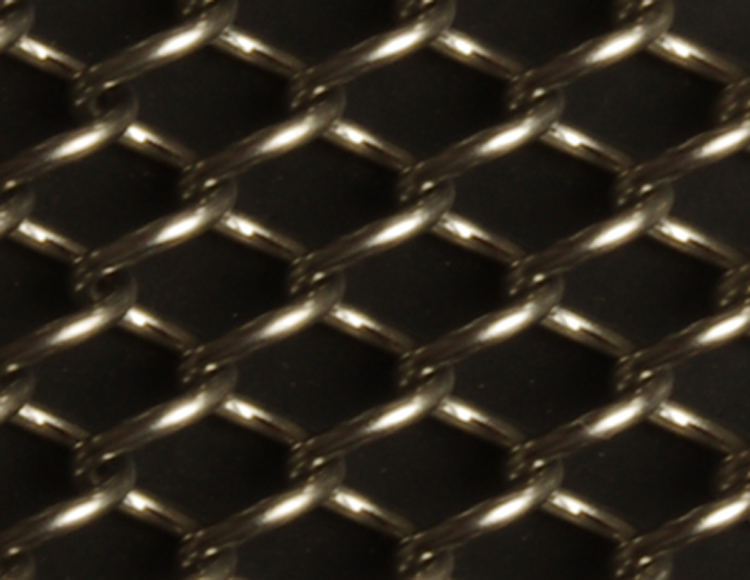
Stainless steel 304 / 316
Finish mill, satin, mirror, PVD
Best for interiors, ceilings, high-traffic partitions
Avoid mirror polish near salt spray
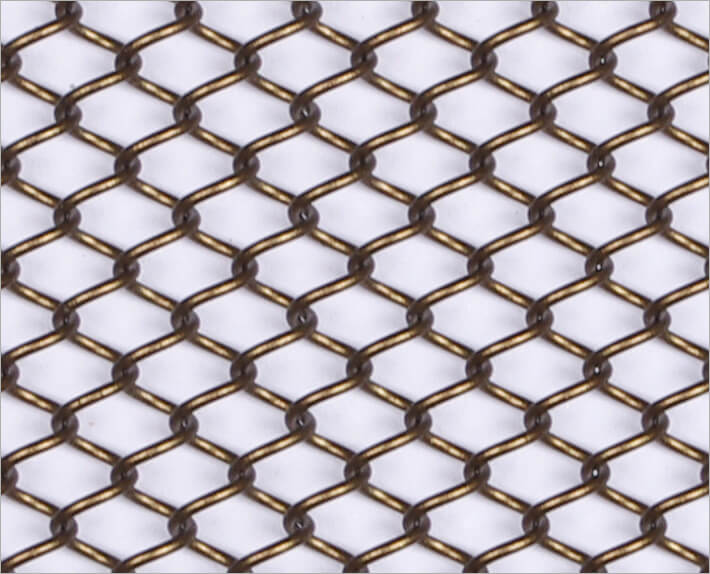
Aluminum
Finish polished, satin, antique, clear-coated
Best for lobbies, hospitality, warm-tone schemes
Avoid uncoated brass where a fixed colour is specified
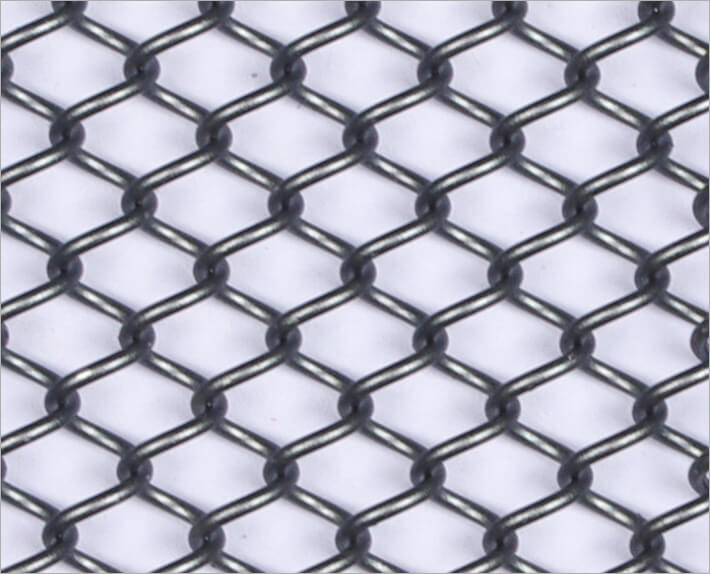
Carbon Steel
Finish polished, brushed, antique
Best for feature walls where patina is welcome
Avoid exposed exterior without a coating decision
Aluminium is also produced for lighter, wider curtains and for exterior screens where weight is the controlling factor. Tell us the environment — interior, humid, coastal or exterior — and we will narrow the alloy before we talk about colour.
How it is made
Five steps, all in one plant — which is why the edge detail and the finish can be matched to the sample you approved.
- Wire drawn to diameter and, if required, coated.
- Wire coiled into uniform rings on a mandrel.
- Rings cross-linked into a continuous diamond sheet.
- Sheet cleaned, levelled and cut to the opening size.
- Edges folded, wire ends captured, finish applied.
Coil drapery compared with the alternatives
Four materials get specified for the same job. The differences that decide it are transparency, weight and how the sheet behaves on a curve.
| Solution | Transparent both ways | Weight | Curves & folds | Relative cost |
|---|---|---|---|---|
| Coil drapery | High | Light | Yes — track or swag | Medium |
| Woven wire drapery | Medium | Medium | Yes — drapes | Medium–high |
| Chain curtain | High | Medium | Vertical only | Medium |
| Perforated screen | Low | Heavy | Flat panels only | Medium |
| Solid panel / board | None | Heavy | Flat or pre-formed | Low |
Rule of thumb: if the space must stay visually connected and the structure is light, coil drapery. If the surface must read as a woven cloth rather than a chain mail, woven wire drapery. If it must be a rigid plane with a precise hole pattern, perforated screen.
Installation and fixing
Ceiling track (swivel)
The usual choice for partitions and window treatment. Curtains hang from a track with swivel hooks so they can be drawn open and stacked to one side.
Tensioned frame
Gives the flattest, most architectural face — used on ceiling rafts and large wall coverings where folds are not wanted. Requires setting out on site.
Hook-on carrier
Individual curtains can be lifted off for access to services behind. Tighter dimensional tolerance, and the top edge must be properly finished.
Load is carried by the track and its fixings, not by the mesh. At 2.0 kg/m² a 3 m × 4 m curtain adds roughly 24 kg to the structure — tell us the substrate and we will say what the track needs. Setting-out drawings go out with the order.
Where coil drapery is used
Partition & screen
Room dividers, lobby screens and elevator surrounds. See the application →
Wall covering
Interior and exterior cladding with mesh panels. See the application →
Glass interlayer
Mesh for laminated glass floors, balustrades and façades. See the application →
Ceilings and canopies
Mesh rafts and dropped ceilings that conceal services. All applications →
Recent work and samples
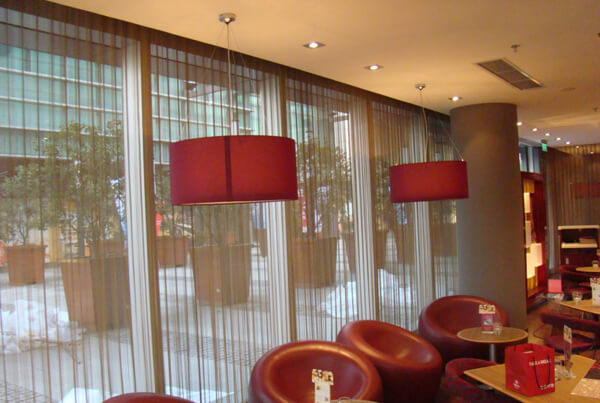
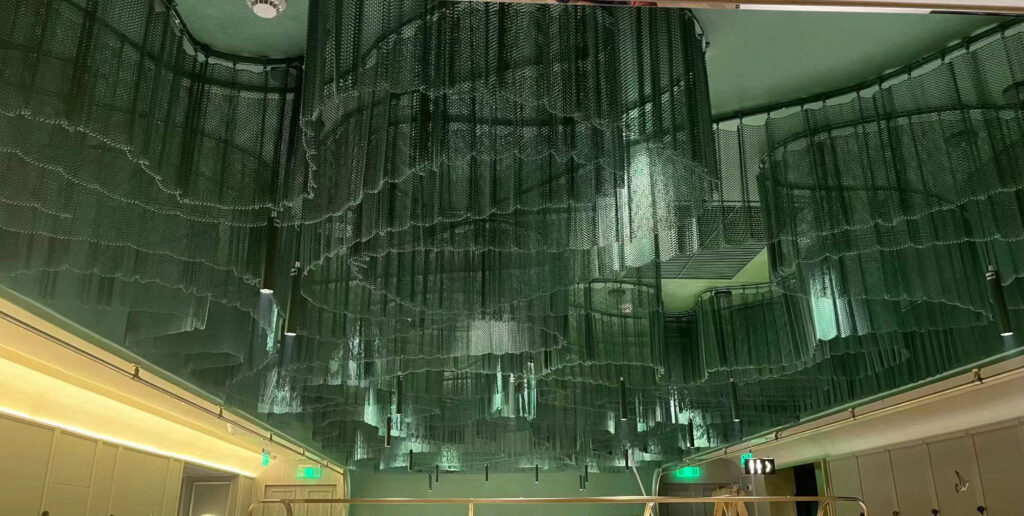
Panels are produced to project drawings and shipped to facade contractors, fit-out companies and glass laminators. If the finish is still open, start with a sample: an A4 piece in the alloy and colour you are considering, sent free of charge, before any production commitment.
Ordering, samples and lead times
| Item | Detail |
|---|---|
| Minimum order | 10 m² |
| Sample | Free A4, 7 days |
| Stock specification | 1 week |
| Custom production | Confirmed at quotation |
| Packing | Carton and pallet, edge protected |
| Terms | FOB / CIF / DDP |
| Documents | Material test report, packing list, invoice |
| Drawing support | Setting-out drawings included |
Fire performance. The curtain contains no fabric, foam or adhesive, so it adds no fuel load of its own. If your project needs a documented rating, tell us the standard and we will confirm which test reports we hold — we will not quote a class we cannot evidence.
Frequently asked questions
What is metal coil drapery made of?
Coiled wire — normally stainless steel 304 or 316, and also aluminium, brass or copper. The wire is coiled into rings and cross-linked into a diamond mesh; there is no fabric, coating or backing in the sheet itself.
How much does it weigh, and can my ceiling carry it?
The standard build is about 2.0 kg/m², so a 3 m × 4 m curtain is roughly 24 kg plus the track. The load goes into the track and its fixings rather than the mesh, so the real question is the substrate — send us what the ceiling is built from and we will confirm the fixing.
What is the maximum width you can make?
Curtains are made to your opening rather than cut from a standard sheet, so there is no fixed maximum width. On very wide openings we weave to modules and set the joints on the drawing, so seams land where you want them.
Can it be used outdoors?
It is primarily an interior product. For exterior screens we would normally specify 316 or aluminium and confirm the finish first, because wind movement and surface protection matter more outside than inside.
Does it need a track, or can it be fixed directly?
Either. A ceiling track lets the curtain be drawn and stacked; a tensioned frame holds it flat against a wall or ceiling. Both are supplied to the same mesh — only the edge detail changes.
How is it cleaned?
Dust with a soft brush or vacuum on low suction. For marks, wipe with a damp cloth and mild detergent, then dry — mirror-polished surfaces show water marks, so dry rather than air-dry.
Can you match a RAL or Pantone colour?
Yes, through PVD coating, which is more durable than lacquer and does not chalk. Send the reference and we will return a sample for approval before production.
Are the wire ends sharp, and does the edge fray?
No. Edges are folded and the wire ends captured, so nothing is left exposed and the mesh cannot unravel — that is the main difference from a cut woven sheet.
What is the minimum order and lead time?
MOQ is 10 m². The standard specification ships in about a week; custom sizes and finishes are confirmed at quotation. A free A4 sample takes about 7 days.
Request a quote for metal coil drapery
Send an opening size, a sketch or a reference photo. We will come back with the alloy, the aperture, the track and a price — or send a sample first if the finish is still open.
Sales: sales@decorwiremesh.com · Reply within one working day · Setting-out drawings with every order.