
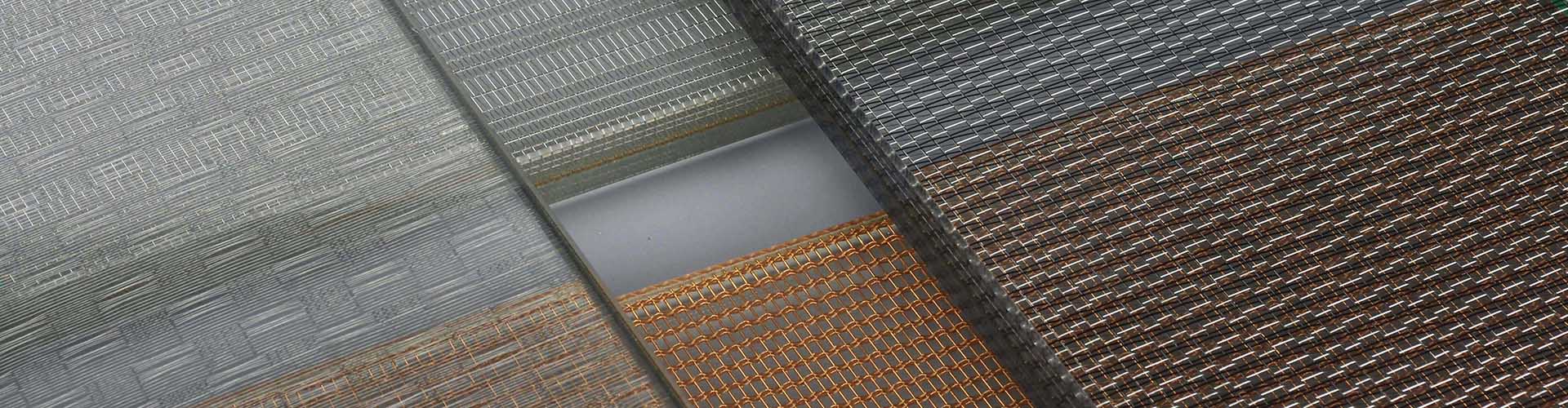
A metal mesh interlayer puts the pattern inside the glass. Woven mesh is laminated between two glass plies, so the surface you touch is glass and the pattern cannot tarnish, be picked at or collect dust. It is specified for balustrades, glass floors, door panels and feature glazing —anywhere the decoration has to survive being handled.
Pattern inside the laminateEVA or PVBGlass processor laminatesMade to panel size
Free A4 sample · setting-out drawings · export packing and full document set.
What decides an interlayer brief
This is the one product where two factories are involved, so the questions are about the split:
- Who laminates? We weave the mesh; a glass processor laminates it. The lamination window, the warranty and the glass build-up sit with them —which is why we ask for their name early.
- What is the build-up? Glass thickness, interlayer type (EVA or PVB) and panel size are set by the engineer. The mesh has to fit inside that, not the other way round.
- Where is the pattern seen? From outside, a laminate reads as a tint; from close up, as a weave. Both have to be approved on a real sample, because the glass adds a slight tone.
- What touches the panel? If it is a balustrade or a door, the pattern must clear the shoe or clamp. Edge clearance is decided at specification, not on site.
Three mesh options inside the glass
The mesh inside the laminate can come from any of the woven meshes —the choice is about tone and density, not about performance.
Laminated glass metal mesh
The interlayer product itself: mesh bonded between plies. Start here for build-ups and panel sizes. See the mesh →
Woven mesh
The denser crimped weave, used where the pattern should read as a texture behind the glass. See the mesh →
Metal coil drapery
The more open chain-mail mesh —but as an interlayer it is normally replaced by a woven pattern, because the aperture is too large for lamination. See the mesh →
Four interlayer configurations
Balustrade infill
Glass carries the load, mesh decorates. The pattern is set to clear the shoe or the clamps at the bottom edge.
Glass floor and treads
Mesh gives a visible pattern inside a structural laminate. Aperture and density are set with the engineer, because the panel has to read as a walking surface.
Door and partition panels
The most handled location on any project —and the reason to put the pattern inside rather than on the surface.
Feature glazing and spandrels
Backlit or daylit panels where the mesh is the design idea. The light source behind the glass changes the tone.
Constraint to approach
| Requirement | Approach | The trade-off |
|---|---|---|
| Pattern must survive handling | Mesh inside the laminate | Cannot be changed after lamination |
| Safety behaviour | Laminated build-up specified by the engineer | Mesh decorates; it does not add strength |
| Edge clearance for fixings | Pattern and edge distance agreed before lamination | Reduces the decorated area |
| Colour consistency | Mesh approved as a physical laminate sample | Glass adds a slight tint that shifts the tone |
| Tempering after lamination | Not possible —heat-treatment order is set by the processor | Constrains the build-up sequence |
| Large panels | Coordinated with the processor’s line capacity | Handling, not the mesh, is usually the limit |
Detailing and fixing
Edge clearance and clamps
Balustrade shoes, point fixings and clamps all need clear glass at the edge. The mesh pattern is laid out to leave that band clean.
Interlayer window
The processor needs a lamination window with the mesh cut slightly inside the glass edge, so no wire reaches the exposed edge.
Joints between panels
A run of glass panels reads as one surface only if the pattern lines up across joints —which means the panels are numbered and laid out together, not cut independently.
Send the processor’s build-up with the enquiry: glass thickness, interlayer type, panel size and edge conditions. We confirm the mesh against it; they confirm the lamination. Keeping that split explicit is what stops a sample being approved that the line cannot run.
Sequence from spec to site
Two factories means two schedules, and the mesh is the earlier one:
- Confirm the glass build-up and the processor with the project team.
- Approve the mesh as a physical laminate sample, not a flat swatch.
- Cut the mesh to the lamination window and ship to the processor.
- Processor laminates, then the panels are numbered and packed.
- Site: check the panel numbering against the drawing before installation.
Documents and compliance
We supply the mesh and the cutting layout. The processor supplies the lamination and its own documentation for the glass build-up. We provide the material test report for the mesh and the packing list for the shipment.
We do not certify the glass panel. Safety behaviour, impact class and thermal performance belong to the laminated build-up and the processor, and we will say so rather than let a specification assume otherwise.
Sample laminates
Approve this product on a laminate sample. The mesh tone behind glass is different from the flat swatch, and a screen render will not show it.
Ordering and lead times
| Item | Detail |
|---|---|
| Minimum order | Confirmed at quotation |
| Sample | Laminate sample on request |
| Lead time | Confirmed with the glass processor |
| Packing | Export carton and pallet, edge protected |
| Documents | Material test report, packing list, invoice |
| Terms | FOB / CIF / DDP |
| Drawing support | Setting-out drawings with the order |
Tell us whether we are supplying mesh to your processor or coordinating the panel —it changes who owns the lamination window.
Frequently asked questions
Can the glass be tempered after lamination?
No. Heat treatment is decided by the processor and usually happens before lamination, so the build-up order is fixed early. This is a question for the processor, and we will flag it at specification stage.
Does the mesh weaken the glass?
The mesh is inside the interlayer and decorates it. Strength and safety behaviour come from the laminated build-up, which the engineer and the processor set.
How much light does it block?
It depends on the aperture and the alloy. An open weave reads as a veil; a dense one as a tint. A laminate sample held against a window is the quickest honest test.
What is the maximum panel size?
Set by the processor’s line and by handling, not by the mesh. Give us their maximum and the mesh will be cut to fit inside it.
Who does the lamination?
A glass processor. We can work with yours, or coordinate with one —but the lamination window and its warranty sit with them.
Can the mesh be coloured?
Yes: stainless, copper, brass or aluminium, and etched, coated or gradient-finished before lamination.
How is it cleaned?
It is glass on both faces, so normal glass cleaning applies. The mesh cannot be reached by a cloth.
What drives the cost?
The glass build-up first, then the mesh. A laminate sample costs more than a flat swatch because the processor has to run it.
Send the glass build-up for a mesh quote
Glass thickness, interlayer type, panel size and the pattern you want. That is enough for us to confirm the mesh and price it.
Sales: sales@decorwiremesh.com · Reply within one working day · Setting-out drawings with every order.