
Mesh for safety and security is a load case before it is a material. Rope mesh and rigid mesh panels are used for balustrades, void protection, enclosures and guarding, and what decides the specification is the load, the permitted deflection and the aperture 鈥?not the pattern. We supply the net, the tensioning detail and a schedule that states what the net is designed to do.
Rope or rigid meshAperture to your requirement316 for exposed sitesTensioning schedule
Free A4 sample · setting-out drawings · export packing and full document set.
What decides a safety brief
Four questions, and the first one is usually the one that gets skipped:
- What is it protecting against? A body falling, an object falling, or someone climbing. Each sets a different aperture and a different load case.
- What deflection is acceptable? A net sized to breaking strength will still deflect visibly. Deflection, not strength, is normally the governing criterion on a balustrade.
- Who checks the numbers? We size the net and state the load case; the structural engineer checks the posts and the fixings. Being explicit about that split prevents a nasty surprise at handover.
- What is the environment? 316 for coastal, marine or chemically exposed sites. Corrosion is the failure mode that actually happens in service.
Three systems for safety work
The choice is about how much has to be seen through the barrier, and how it is fixed.
Rope mesh
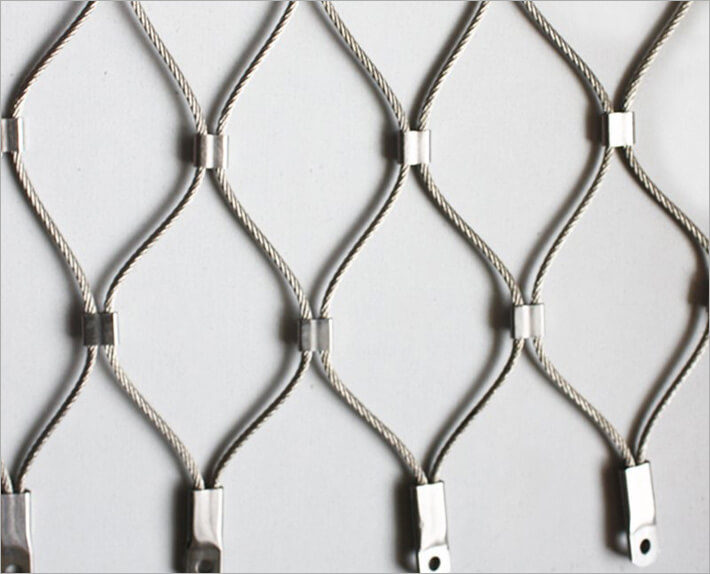
Cable net tensioned between posts. Nearly invisible at a distance, and the usual choice for balustrades and enclosures. See the mesh →
Woven mesh panels
Rigid panels in frames. Where a fixed plane is wanted, or where the aperture must not deform under load. See the mesh →
Laminated glass mesh
Glass with a mesh interlayer, where guarding also has to be a decorative element. See the mesh →
Four guarding configurations
Balustrade infill
Net tensioned between posts, or panels set into a shoe. The fixing determines the edge detail and the deflection.
Void and roof-edge protection
Larger spans with a specific load case. Intermediate supports may be needed, and the schedule will say so.
Enclosures
Animal, plant or equipment enclosures. Aperture is set by what must not pass through; the net is often chosen because it disappears visually.
Climb-resistant screens
Where the barrier must also resist climbing, the aperture and the tension are specified together 鈥?a loose net is easier to climb than a taut one.
Constraint to approach
| Requirement | Approach | The trade-off |
|---|---|---|
| Fall protection | Rope net sized to a stated deflection | Visible sag if the posts are too far apart |
| Object retention | Smaller aperture, or a second layer | Denser mesh reads as a solid screen |
| Climb resistance | Taut net, smaller aperture, no handholds | Tensioning needs a suitable frame |
| Coastal exposure | 316 cable and stainless ferrules | Cost, and longer lead time |
| Inspection regime | Ferruled construction, crossing by crossing | Sleeveless mesh is harder to inspect |
| Large spans | Intermediate supports and a revised schedule | More posts, more cost |
Tensioning and fixing
Posts and anchors
The net is only as good as what it is tied to. Post centres, anchor type and the substrate are part of the load path, and the engineer checks them.
Edge ropes and tensioners
The perimeter is normally a heavier rope with turnbuckles, so tension can be set on site and adjusted later.
Corners and penetrations
Every corner and every penetration interrupts the load path. These details are drawn, not improvised 鈥?and they are the ones to review before fabrication.
Send the span, the post centres, the load case and the environment. The tensioning schedule comes back with the cable size, the aperture and the deflection the net is designed to 鈥?the document a checking engineer will ask for.
Sequence on site
Safety work is inspected, so the sequence has to leave evidence:
- Fix posts and anchors to the engineer’s detail.
- Confirm post centres against the schedule before the net is made.
- Hang and tension the net; record the tension.
- Inspect crossings and terminations, photograph for the file.
- Hand over with the schedule and the inspection record.
Documents and compliance
We supply the net, the tensioning schedule and the material test report. The schedule states the cable, the aperture and the design deflection 鈥?the numbers a checking engineer needs.
We do not certify the installation. Anchors, posts and the supporting structure belong to the engineer of record. Our job is to state what the net does and what it needs, clearly enough that someone else can check it.
Net samples and schedule
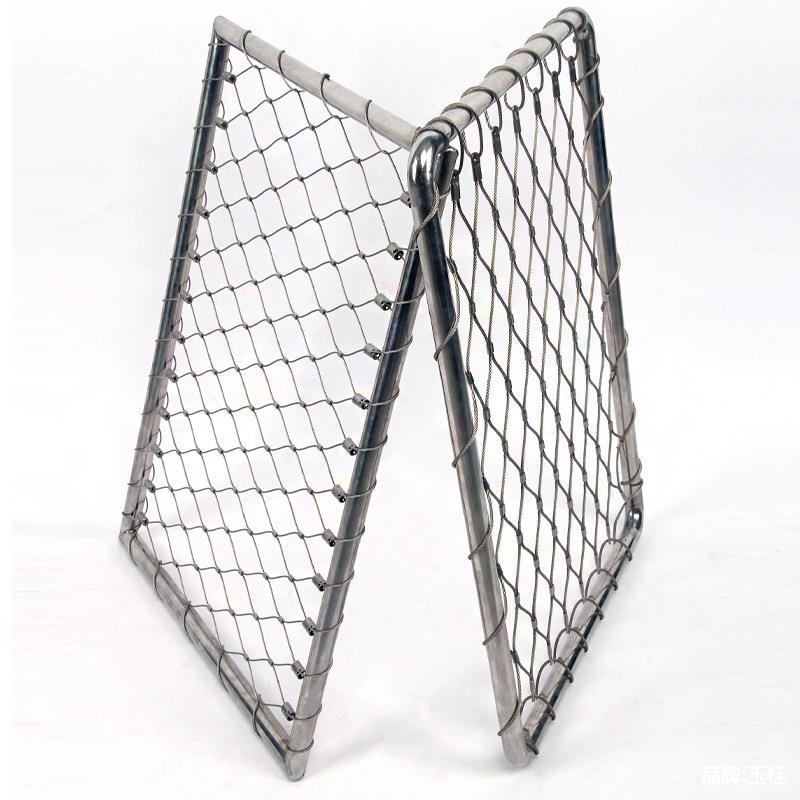
For safety work, ask for the sample and the schedule together. A sample without the numbers is a decoration, not a specification.
Ordering and lead times
| Item | Detail |
|---|---|
| Minimum order | Confirmed at quotation |
| Sample | Net sample on request |
| Lead time | Confirmed with the tensioning schedule |
| Packing | Export carton and pallet, edge protected |
| Documents | Material test report, packing list, invoice |
| Terms | FOB / CIF / DDP |
| Drawing support | Setting-out drawings with the order |
Fixings must be confirmed before fabrication 鈥?a 20 mm error at the posts becomes visible sag at mid-span.
Frequently asked questions
Is rope mesh suitable for fall protection?
It is used for it, but suitability is a design question: load case, deflection and the supporting structure all have to be checked. We size the net and state the design deflection; the engineer checks the rest.
What load should I specify?
That comes from the applicable code and the use, not from us. Give us the load case and we will size the cable and state the resulting deflection.
How do I stop small objects passing through?
Reduce the aperture. It is a spacing change, not a second material 鈥?but the visual result is a denser screen.
Can it be used near the sea?
Yes, with 316 cable and stainless ferrules. Rinse periodically; avoid chloride-based cleaners.
Will it sag?
A correctly tensioned net does not. Tension is set on site and recorded, and the schedule states what it should be.
How is it inspected?
Ferruled construction is inspected crossing by crossing. Sleeveless mesh is cleaner but harder to inspect, which matters on safety-critical work.
Do you provide certification?
We provide the material test report and the tensioning schedule. Structural certification of the installation sits with the engineer of record, and we will say so plainly.
What is the typical minimum order and lead time?
Confirmed at quotation. Nets are made to the opening, so the fixing centres have to be confirmed before production starts.
Send the span and the load case
Post centres, height, what the barrier has to stop and the environment. We will size the net, state the deflection and send the schedule.
Sales: sales@decorwiremesh.com · Reply within one working day · Setting-out drawings with every order.