
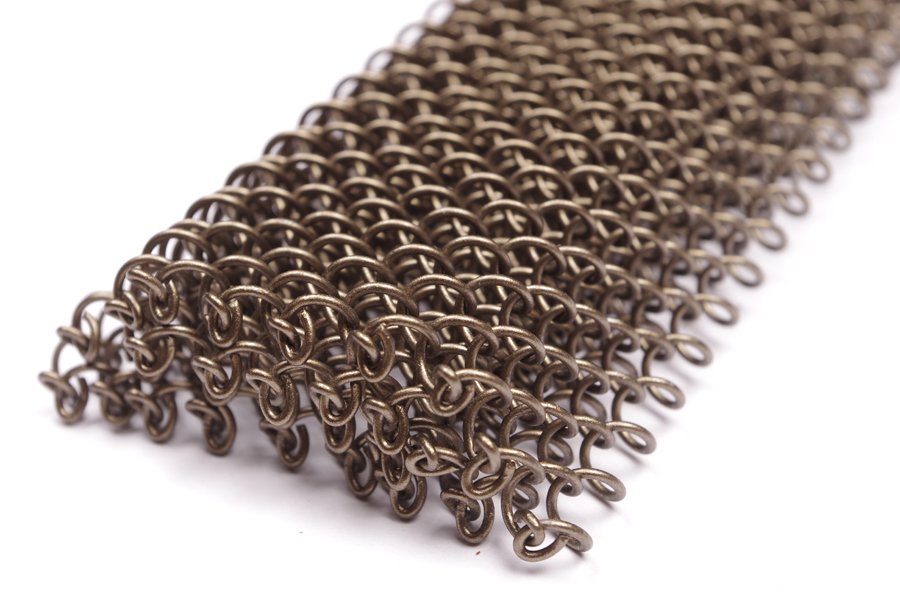
A coil mesh curtain is a difficult product to photograph honestly. In a sample bag it looks like a length of chain mail. Hanging three metres high in a hotel lobby, lit from one side, it behaves like fabric: it folds, it holds a shadow, and you can see through it in both directions.
That gap between the sample and the finished installation is why this material is specified well as often as it is specified badly. What follows is a plain account of what metal coil drapery is, where it earns its place, and the four decisions that actually change the result.
What it is, in construction terms
Coil drapery is wire coiled into rings and then cross-linked into a flat diamond sheet. There is no warp and weft, so there are no stiff crimp points; the sheet folds without creasing, which is the whole reason it can hang on a curtain track at all.
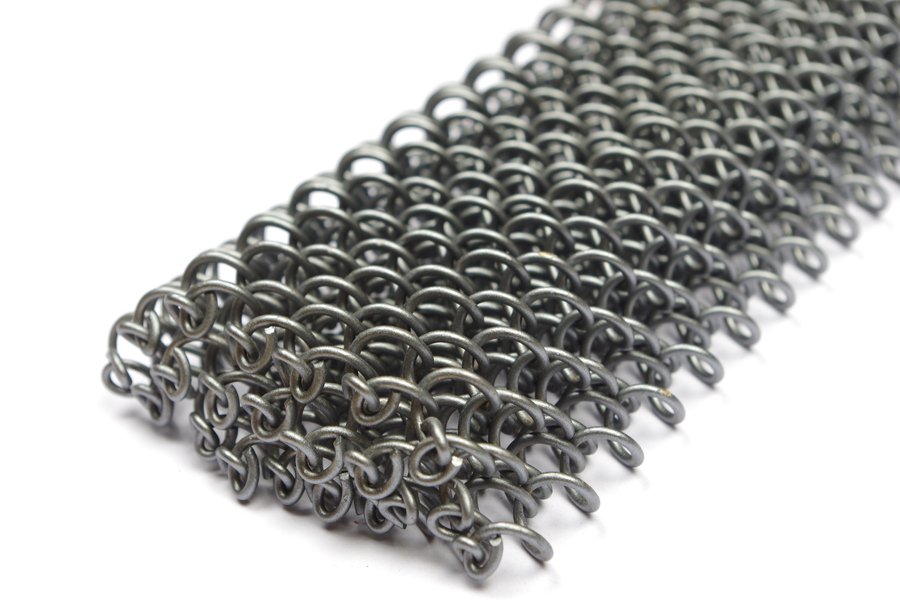
The standard build we run is 1.2 mm wire, 8.5 mm aperture, 7.1 mm overall thickness, around 2.0 kg/m². Those four numbers do most of the work. Aperture and wire set how transparent the curtain reads and how much it weighs; the weight is what the track and the ceiling have to carry.
Everything else — alloy, finish, panel edge — sits on top of that. Stainless 304 or 316, aluminium, brass and copper are all woven in the same way, and a PVD coat will give you bronze, black or champagne if the scheme needs a colour rather than a metal.
Where it works
Partitions and screens
This is the most common use, and the one with the clearest brief: divide a space without darkening either side. Because the open area is uniform across the sheet, a ceiling above the partition does not go gloomy on one side.
Ceiling features
A hanging curtain above a bar or a reception desk hides ductwork and sprinkler runs while keeping the volume of the room. It is also forgiving: services above a coil mesh ceiling can be changed without taking a solid ceiling down.
Window treatment
Coil mesh filters a view rather than blocking it. On a west-facing glazed wall it takes the hard edge off late afternoon light without turning the room into a box.
Where it does not work
Three honest exclusions. It does not absorb sound — a bare coil curtain is acoustically almost transparent, and if the room is echoey you need a backing behind it. It does not give privacy on its own; a single layer filters, and you need a second layer offset by half an aperture before anyone stops being visible. And it is an interior product: outdoors, wind movement and surface protection matter far more than the pattern.
The four decisions that change the result
- Aperture. Between 6 and 12 mm in normal work. Wider reads more transparent and lighter; narrower reads denser and hides more of what is behind it.
- Wire. 1.0 to 2.0 mm. Heavier wire holds a wider fold and survives a circulation area; finer wire drapes more softly.
- Finish. Mill, satin, mirror, antique or PVD. Mirror shows every water mark, so it belongs where nobody touches it and nobody wipes it with a wet cloth.
- Fixing. Ceiling track with swivel hooks if the curtain has to open; tensioned frame if it has to sit flat; hook-on carrier if panels must come off for access.
Get the fixing wrong and everything downstream is a compromise. A curtain made to one carrier pitch will not hang evenly on another, which is why we ask for the track detail before the panel is cut rather than after.
Coil drapery, or woven wire drapery?
These two are the closest pair in our range and we get asked to choose between them most weeks. The difference is texture, not performance.
Coil drapery is springy and open — a chain-mail reading, wider folds, more transparency. Woven wire drapery is crimped cloth: flatter, denser, and it hangs in soft vertical pleats that read as fabric from across a room.
If the client says “I want it to look like a curtain”, they mean woven. If they say “I want to see through it”, they mean coil.
Installation, briefly
The load goes into the track and its fixings, not into the mesh. At 2.0 kg/m² a 3 m × 4 m curtain is roughly 24 kg plus the track, which is usually manageable — but on a retrofit ceiling the track, not the mesh, is the constraint. Tell us what the ceiling is built from and we will say what the fixing needs.
Every order ships with setting-out drawings so the track can be positioned before the panels arrive. That sounds bureaucratic until you have watched an installer try to land a 3 m curtain on a track that is 20 mm off the centre line.
Keeping it looking right
Dust with a soft brush or a vacuum on low suction. For marks, a damp cloth with mild detergent, then dry — and dry it properly, because a mirror-polished surface will show the water mark long after the cloth has gone. No abrasive pads on satin or mirror finishes, and no chloride cleaners anywhere near 304.
Samples and ordering
A free A4 sample is normally sent within about a week. If the curtain has to hang in folds, ask for a hanging piece rather than a flat one; the sample shows the aperture and the finish, but only a hanging piece shows whether the fold is what you had in mind.
The standard build is held in stock and ships in about a week. Custom sizes, colours and heavier wire are confirmed at quotation. Minimum order is 10 m².
Three questions we get most often
Does it block the view?
It filters it. A single layer blurs what is behind; two layers offset by half an aperture will stop a person being recognisable. If you need real privacy, specify two layers.
Can it be used outdoors?
It is an interior product. For an exterior screen we would move to 316 or aluminium and confirm the finish first, because wind movement and surface protection dominate outside.
Will the edge fray?
No. Edges are folded and the wire ends captured, so nothing is exposed and the sheet cannot unravel. That is the difference between coil mesh and a cut piece of woven cloth.
If you are still deciding between families, the metal coil drapery page carries the full specification table, or send an opening size and a photograph of the space and we will tell you which one is worth pursuing. More of our partition work is documented under partitions and screens.
One more decision rule worth knowing. If the requirement turns out to be guarding rather than dividing, a cable net is the right family — often almost invisible at distance — and that is a different specification altogether: see stainless steel rope mesh. If the brief is really about a flat interior surface rather than a hanging curtain, start instead with woven metal interiors.
1 thought on “Metal Coil Drapery: What It Is, and Where It Actually Works”