
The first thing people say about a rope mesh enclosure is that they cannot see it. Standing three metres away it is almost invisible; two metres closer it becomes a diamond grid of thin cable, and up close you can see the ferrules that hold every crossing together.
That disappearing act is the whole point of the material, and it is also why rope mesh gets specified confidently and then argued about on site. It is a structural product that looks like a decoration, so the conversation has to cover both.
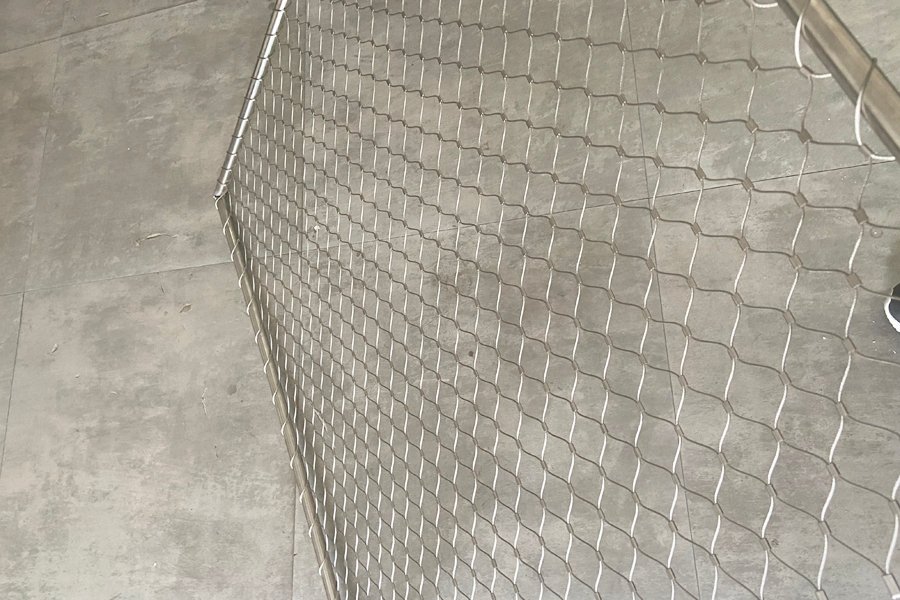
What it actually is
Stainless steel rope mesh is a cable net. Wire ropes run in two directions and are joined at every crossing — crimped into a ferrule, or interwoven in a sleeveless construction — so the sheet holds a diamond aperture without any frame behind it.
Two details decide almost everything downstream:
- The strand. 7×7 is stiffer and holds a flatter plane; 7×19 is more flexible and easier to shape around a curve.
- The joint. Ferruled construction gives a defined diamond and can be inspected crossing by crossing. Sleeveless (often called Webnet) removes the fittings for a cleaner line, but the joins are harder to see and therefore harder to check.
Cable diameter runs from about 1.2 mm to 4.0 mm in normal architectural work. Aperture is set by the spacing of the cables, anywhere from 20 mm to 200 mm, which means you can change the visual density without changing the fixing.
Strength is not the design criterion. Deflection is.
This is the part that catches people out. A rope net sized to its breaking strength will still visibly sag when someone leans on it, and on a balustrade the sag is what the client notices, not the load capacity.
So the design question is: what deflection are we designing to, over what span, with posts at what centres? Give those three numbers to a supplier and you get a cable size and a tensioning schedule. Give them a span alone and you get a guess.
Which is also why the frame matters as much as the net. The posts and anchors take the tension, and tension is what keeps the net from sagging. A beautiful net on undersized posts is a bad installation with good marketing.
Where rope mesh earns its place
Aviaries and animal enclosures
The obvious one, and still the best argument for the material: an enclosure that does not read as a cage. Birds and animals are visible through it, the structure disappears at distance, and the aperture can be set to what must not get out — or in.
Balustrades and guarding
A cable net gives the visual lightness of glass without the reflection or the cleaning. It is specified on atriums, mezzanines and stair voids where the guard has to be there but should not become a wall.
Green walls and facade support
Climbing plants need something to hold on to that will not corrode and will not need painting. A rope net fixed off a facade does that, and it lets the planting read as a surface rather than a trellis.
Fall protection
Void protection and roof edges, usually with a smaller aperture and a documented load case. The net is often chosen here because a solid barrier would change how the space looks from below.
The three things that go wrong
Post centres chosen for symmetry rather than structure. The net will hold, but it will sag in the middle of every bay. Either move the posts or accept a heavier cable.
304 instead of 316. Near the coast, around a pool, or anywhere chlorides are present, 304 will stain and eventually pit. The grade is cheaper to upgrade than to replace.
No tensioning schedule. A net that is hung rather than tensioned looks fine for a month and then starts to belly. Tension has to be set after installation and recorded, because the next person to touch it will need a number.
Installation, briefly
Rope nets are made to the opening, not cut from a roll, so the fixing centres have to be confirmed before fabrication. A 20 mm error at the posts becomes visible sag at mid-span, and no amount of tensioning will take it out.
The perimeter is normally a heavier rope with turnbuckles, so tension can be adjusted on site. Corners, penetrations and terminations all interrupt the load path — those are the details to review on a drawing before anything is made, not the diamond pattern.
Maintenance and inspection
Little is needed, and that is part of the appeal. A fresh-water rinse in coastal installations and a soft brush for dust will cover most of it. Avoid chloride-based cleaners on 304 entirely.
On safety-critical installations, inspect the crossings. Ferruled construction makes that practical: every joint can be seen and felt. Record what you find, because an inspection regime is only useful if the next inspection has something to compare against.
Samples, schedules and the paperwork
For a barrier, ask for the sample and the tensioning schedule together. A sample without the numbers is a decoration; the schedule is the document a checking engineer will ask for, and it should state the cable, the aperture and the design deflection.
Panels are made to your opening, so lead time starts after the fixing centres are confirmed. Minimum order and schedule are agreed at quotation, because both depend on the cable and the ferrule rather than on area alone.
The full specification sits on the stainless steel rope mesh page; the load-case and inspection side is covered under safety and security, and if the net is being used as a divider rather than a barrier, start with partitions and screens.
If you have a span, a post spacing and a load case, send them over. That is enough to size the cable, state the deflection and tell you whether the design is realistic before anyone draws it.
Two adjacent cases are worth reading next: woven metal interiors covers mesh used as a surface rather than a barrier, and metal coil drapery covers the curtain case, where transparency and fold matter more than load.
1 thought on “Stainless Steel Rope Mesh: Strength You Can See Through”